
Straight Answers to Remodeling Questions
What things cost, how long they take, what needs a permit and which materials hold up in Southern California, answered by a licensed contractor with 35+ years in the trade.
50 answers
How much does a bathroom remodel cost in Southern California?
A bathroom remodel in Southern California typically costs $15,000 to $50,000+. A hall bath refresh that keeps the layout runs $15,000 to $25,000, a tub-to-shower or full remodel $25,000 to $35,000, and a primary suite $35,000 to $50,000+. Legacy prices every project from a written estimate after a free in-home consultation.
How much does a tub-to-shower conversion cost in Temecula?
A tub-to-shower conversion in Temecula typically costs $25,000 to $35,000 with Legacy Construction & Design. That covers removing the tub, building a waterproofed shower pan at the existing drain, custom tile with a niche or bench, frameless glass and a new vanity. Prices are the same across every city we serve.
How long does a bathroom remodel take?
A standard bathroom remodel takes 8 to 12 days of on-site work, and a primary suite takes 2 to 4 weeks. Before demolition, allow 1 to 2 weeks for design and selections and 1 to 4 weeks for tile, the vanity and fixtures to arrive. We confirm deliveries before scheduling the start.
How is a shower waterproofed during a bathroom remodel?
A shower is waterproofed with a sloped shower pan and a waterproofing membrane behind the tile, not with tile and grout alone. Tile and grout shed most water, but some always works through. The membrane stops it before it reaches the framing or subfloor, and we water-test the pan before any tile goes in.
Frameless vs semi-frameless shower glass: which should I choose?
Frameless glass uses thick panels with minimal hardware and gives the most open look, while semi-frameless puts a slim metal frame around the perimeter and costs less. Both work well on a walk-in shower. Frameless suits tile you want to show off, and semi-frameless suits a clean look on a tighter budget.
Can I use my bathroom during a remodel if it's my only one?
Not for most of the project. The shower is out of use from demolition until the tile and glass are done, and the toilet is disconnected for part of the work. Many homeowners with one bathroom shower at a gym or with family, and we walk through which days the toilet is offline before we start.
How much does an accessible bathroom cost?
An accessible bathroom conversion typically costs $15,000 to $25,000. A bathroom safety conversion runs $15,000 to $20,000, and a fully accessible bathroom with a shower seat, roll-under vanity and brighter lighting runs $20,000 to $25,000. Whole-home safety upgrades start at $25,000, while smaller jobs such as grab bars alone cost less.
What makes a bathroom ADA compliant in a private home?
The ADA legally covers public accommodations and commercial facilities, not private homes, so no home bathroom is required to comply. For a home, ADA compliant means built to the 2010 ADA design standards for grab bar height and strength, toilet height, clearances and shower design, adjusted to the person who lives there.
What height should grab bars be, and how are they installed?
Grab bars should be installed 33 to 36 inches above the floor, measured to the top of the bar, beside and behind the toilet and on the shower walls. Each bar must be anchored into solid blocking, not just drywall, and ADA standards call for bars that support 250 lb.
Low-threshold walk-in shower vs curbless shower: which is better?
For most homes on a concrete slab, a low-threshold walk-in shower is the practical choice. It sits in the tub's footprint at the existing drain, with a low curb that is easy to step over. A curbless shower needs the slab cut and recessed, which requires a permit and is outside the projects Legacy takes on.
How much does a living room remodel cost?
A living room remodel in Southern California typically costs $10,000 to $40,000+. New flooring, trim, paint and LED lighting sit at the lower end, a built-in media wall lands in the middle, and a full lighting plan with built-ins on several walls and a new fireplace surround pushes toward the top.
Can I turn a spare bedroom or loft into a home office without moving walls?
Yes, most spare bedrooms and lofts become good home offices without moving a single wall. Custom built-in desks, shelving and file drawers, better lighting, and outlets added where existing wiring allows do most of the work, and the room keeps its current layout so the project stays within permit-free scope.
Engineered hardwood vs. luxury vinyl plank: which is better for a living room?
Engineered hardwood is the better choice if you want real wood that stays stable over a concrete slab, and luxury vinyl plank (LVP) is better for homes with kids, pets or heavy traffic. LVP costs less per square foot and resists water, while engineered hardwood looks and feels like solid wood.
How much do custom built-ins cost?
Custom built-in cabinetry typically costs $3,000 to $15,000+ per unit in Southern California. A single bookcase, window seat or bank of mudroom lockers sits at the lower end, a media wall or office wall falls in the middle, and full closet systems or multi-wall libraries run to the top of the range or above it.
Are built-ins worth it compared to freestanding furniture?
Built-ins are worth it when you want storage that fits the wall exactly, uses the full height to the ceiling, and stays with the house. Freestanding furniture costs less up front and moves with you, but it leaves gaps at walls and ceilings and cannot fill odd alcoves or sloped spaces.
How long do custom built-ins take?
Custom built-ins typically take 3 to 6 weeks from design approval to installation. Design drawings and revisions usually take 1 to 2 weeks before that, and the on-site installation itself is short, typically 1 to 3 days per unit, because most of the work happens in the shop rather than in your home.
How much does it cost to paint a house exterior in Southern California?
Painting a house exterior in Southern California typically costs $3,000 to $10,000+. A single-story home with sound stucco usually runs $3,000 to $6,000, a two-story home $6,000 to $10,000, and larger homes needing stucco repair, trim replacement or a full color change can go past $10,000.
What is the best time of year to paint a house exterior in the Inland Empire?
Spring and fall are the best times to paint a house exterior in the Inland Empire, with mild temperatures, little rain and walls that are not baking in the sun. Summer works when the crew follows the shade around the house, and winter is possible on dry days that stay above the paint's minimum temperature.
How long does exterior paint last in the Southern California sun?
Quality exterior paint typically lasts 7 to 10 years in the Southern California sun when the surfaces are properly prepped and premium products are used. Walls facing south and west wear fastest because they take the most UV, so they often fade and chalk before the shaded sides of the house.
Do I need HOA approval to paint my house in Eastvale?
If your Eastvale home is in an HOA community, you most likely need approval of your exterior color scheme before painting starts. Many HOAs have architectural review and approved color palettes. Repainting itself is generally treated as maintenance and typically does not need a building permit, but HOA rules still apply.
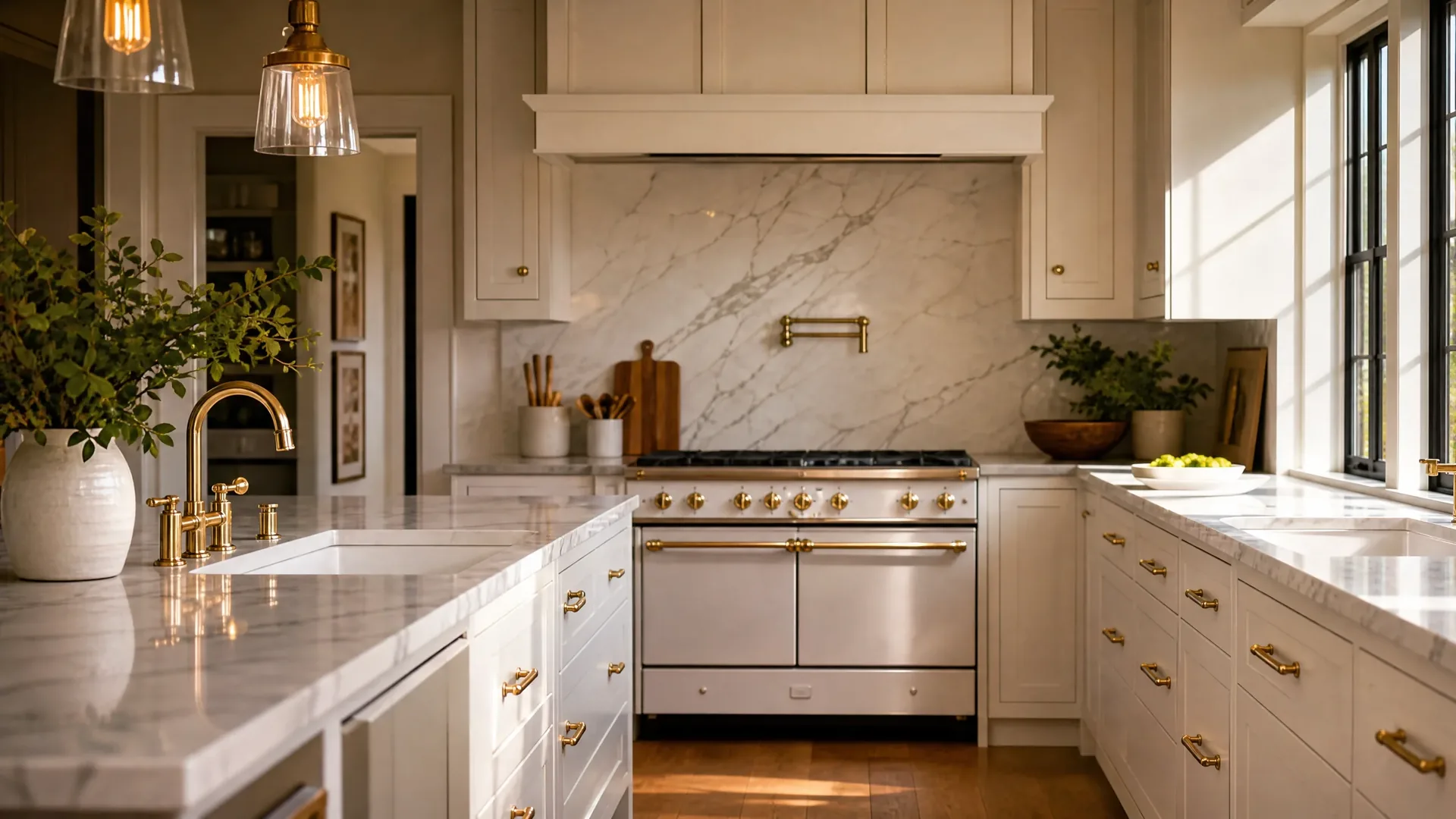
How much does a kitchen remodel cost in Southern California?
A full kitchen remodel in Southern California typically costs $35,000 to $75,000+. Same-layout remodels with semi-custom cabinets usually land between $35,000 and $50,000, upgraded cabinetry and premium stone run $50,000 to $75,000, and full custom luxury kitchens go past $75,000. Your exact number comes from a written estimate after an in-home visit.
How much does a kitchen remodel cost in Corona, CA?
A full kitchen remodel in Corona typically costs $35,000 to $75,000+, the same range we see across Riverside and Orange County. Same-layout remodels with semi-custom cabinets run about $35,000 to $50,000, upgraded kitchens $50,000 to $75,000, and full custom luxury kitchens more than $75,000. A written estimate after an in-home visit sets your exact price.
What makes a kitchen remodel cost more or less?
Cabinetry, countertops and appliances drive most of the cost of a kitchen remodel, and keeping the existing layout is the single biggest way to control it. Full custom cabinets, extra stone slabs for a large island and a pro-grade appliance package push a project up, while semi-custom cabinets and quartz or granite hold it down.
Should I choose semi-custom or custom kitchen cabinets?
Semi-custom cabinets are the right choice for most full kitchen remodels, because they offer a wide range of sizes, finishes and organizers at a moderate price and lead time. Full custom cabinets make sense for unusual spaces, odd ceiling heights or high-end designs that need every box built to the inch, and they cost the most.
Is quartz or granite better for kitchen countertops?
Quartz is better for most busy family kitchens because it is non-porous, never needs sealing and has a consistent color. Granite is better if you cook with a lot of heat or want a natural stone where every slab is unique. Both cost about the same, so the choice usually comes down to maintenance and look.
How long does a kitchen remodel take?
A full kitchen remodel typically takes 3 to 4 weeks of on-site work once cabinets and materials are ready. Before demolition, plan on 1 to 2 weeks for design and selections and 2 to 6 weeks for cabinets and appliances to arrive. Most of the waiting happens before work starts, not during it.
Can you live at home during a kitchen remodel?
Yes, most homeowners live at home during a kitchen remodel. The work area is sealed off, floors and nearby rooms are protected, and many families set up a temporary kitchen with a microwave, refrigerator and access to a nearby sink for the 3 to 4 weeks of on-site work.
Do you need a permit for a kitchen remodel in California?
Often not, if the kitchen keeps its existing layout. Like-for-like work such as new cabinets, countertops, backsplash, flooring and fixtures in the same locations often does not need a permit. Moving walls, relocating plumbing or gas, or adding new electrical circuits does, and that work is outside the projects Legacy takes on.
How can I open up my kitchen without removing walls?
You can make a kitchen feel open without removing walls by using lighter cabinets and countertops, a better lighting plan, continuous flooring into nearby rooms, open shelving in place of some upper cabinets, and an island or peninsula sized to the space. Together these make a closed kitchen feel larger and more connected.
Should I choose kitchen appliances before cabinets?
Yes, choose your appliances before you finalize cabinets. The exact width, depth and height of the range, refrigerator, dishwasher, microwave and hood set the cabinet openings around them. Picking appliances first avoids costly changes once cabinets are ordered, and it lets you confirm the appliances will work with your existing gas and electrical.
How much does a patio cover cost in Southern California?
A custom freestanding wood patio cover in Southern California typically costs $5,000 to $25,000+. An open lattice cover of moderate size sits at the low end, while a solid roof, a larger footprint, heavier beams, lighting and fans push the price toward the top of that range and beyond.
Do I need a permit for a patio cover in Murrieta?
It depends on the cover. In Murrieta, a patio cover attached to the house, or a freestanding cover larger than the city's size limit, needs a building permit, and that work is outside what Legacy takes on. A freestanding cover or pergola under the city's limit typically does not need one.
Is a wood or aluminum patio cover better?
Wood is better if you want a cover that matches your home's trim and rooflines with custom detailing, while aluminum is better if your top priority is the lowest upkeep. Wood needs re-coating every few years in Southern California sun; aluminum does not rot or need stain but comes in set profiles.
How long does a wood patio cover last in the Southern California sun?
A well-built wood patio cover can last for decades in Southern California when the finish is kept up. Sun, not rain, does most of the damage here, so plan to re-coat the stain or paint every few years, and sooner on south and west-facing exposures that take the most heat.
Can you add ceiling fans and lights to a patio cover?
Yes, as long as they run off an existing exterior outlet. Legacy installs outdoor-rated plug-in fans and lights, or low-voltage lighting with its transformer plugged into an existing outlet. A new circuit or hardwired fixture would need an electrical permit, which is outside the projects we take on.
How much does an outdoor kitchen cost?
A custom outdoor kitchen island in Southern California typically costs $10,000 to $50,000+. A straight island with a built-in propane grill and counter space sits at the low end, while a long or L-shaped island with several propane appliances, bar seating and premium stone sits at the high end.
What is the best countertop for an outdoor kitchen in Southern California?
Granite, porcelain slab and concrete are the best countertops for an outdoor kitchen in Southern California, and granite is the most popular choice. Quartz is not recommended outdoors, because UV exposure can discolor or fade the resin that binds it, even though it performs well indoors.
Should I use propane or natural gas for a built-in grill?
Propane is what Legacy builds around for built-in grills. A propane grill with the tank stored inside the island cooks the same way and needs no gas line. Running a natural-gas line to the island requires a permit, and that work is outside the projects we take on.
How long does it take to build an outdoor kitchen?
Most outdoor kitchens take 2 to 4 weeks to build on site, depending on the island's size and how many appliances it holds. Before construction starts, allow time for design, appliance ordering and any HOA approval, since that stretch often takes longer than the build itself.
How is an outdoor refrigerator in an outdoor kitchen powered?
An outdoor-rated refrigerator or beverage center in a Legacy outdoor kitchen plugs into an existing exterior outlet, the same way a patio heater or string lights do. We place the island so the cord reaches that outlet without an extension cord and frame the base so the cord stays out of sight.
How do I check a contractor's license in California?
Use the free license check on the Contractors State License Board (CSLB) website, which shows whether a license is active, its classification, bond and workers' compensation status, and any public complaints. Enter the license number or business name. Legacy Construction & Design holds California License #790442, General Building (B).
What should a remodeling estimate include?
A good remodeling estimate is written and spells out the scope of work, the materials and fixtures included, any allowances, the price, the payment schedule and the expected time on site. It should also say what is not included, so you can compare bids on the same terms and avoid surprises later.
How much contingency should I budget for a remodel?
Setting aside 10 to 15 percent of the project cost as a contingency is common advice for a remodel. That reserve covers things you cannot see until walls and floors are opened, such as damaged subfloor or old plumbing, plus any upgrades you decide on once the work is underway.
What is the best time of year to remodel in Southern California?
Fall and winter are a good planning window for a remodel in Southern California. Mild weather makes it easier to live around the work, and planning in the cooler months lets you finish design and material choices before spring. Inland summers are hot, which matters for outdoor projects and for working with doors open.
What happens at a free in-home remodeling consultation?
At a free in-home consultation, the contractor walks the space with you, listens to what you want, takes measurements and talks through budget, materials and timing. It is also when scope comes up early, including whether an idea would need a building permit. Afterward, you receive a written estimate before any work begins.
What remodeling work does not need a permit in California?
Cosmetic work and like-for-like replacements within the existing layout often do not need a building permit in California, such as new cabinets, countertops, flooring, tile, paint and fixtures in their current locations. Rules vary by city, so check with your local building department. Moving walls, plumbing or gas, or adding circuits typically requires one.
Do I need HOA approval for an interior remodel?
Usually not. Most HOAs focus architectural review on exterior changes, so an interior kitchen or bathroom remodel often needs no approval. Your HOA may still set rules that affect the project, such as allowed work hours, where a dumpster can sit, and where crews can park. Check your CC&Rs or ask management before work starts.
How do I prepare my home for a remodel?
To prepare your home for a remodel, empty the work area completely, set up a temporary kitchen or plan for another bathroom, protect or move fragile items in nearby rooms, and plan where pets and kids will be during work hours. Clear a path from the door to the room and settle parking and access with your contractor.
Which remodel adds the most value to a home?
Kitchens and bathrooms are usually the remodels that add the most value, because they are the rooms buyers notice most and judge most closely. An updated kitchen or bath makes a home feel cared for, while a dated one often reads as a project the next owner will have to pay for.
Remodeling contractors in Corona and the Inland Empire: what should I look for when hiring?
When hiring a remodeling contractor in Corona or the Inland Empire, look for an active California license you can verify on the CSLB website, a detailed written estimate, clear answers about scope and permits, and a contractor who handles all trades with one point of contact. Experience with local homes and HOA rules helps too.
Ask us directly. We answer every question, and the good ones end up here.